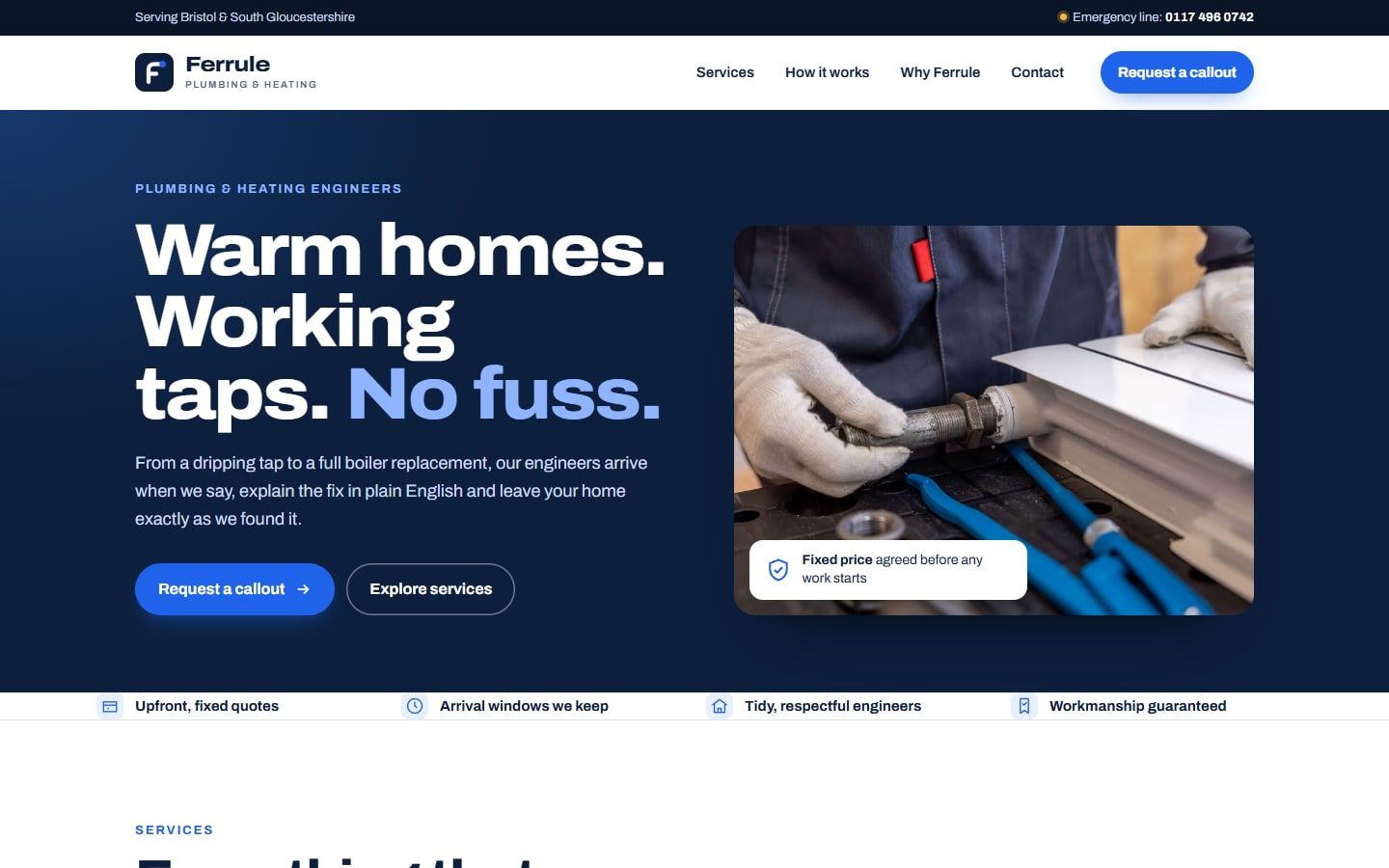
Ferrule Plumbing & Heating
A dependable, conversion-focused homepage for a local plumbing and heating company.
Explore the concept
Custom-coded websites for plumbing and heating businesses across the UK, planned around how your customers actually look for help: on a phone, often in a hurry, wanting to know you cover their area and can be trusted in their home.
01 — Your customers
People rarely browse plumbing websites for pleasure. They arrive with a specific problem or project, and a good website recognises which one quickly.
Something has gone wrong
A leak, no hot water or a boiler showing an error code. They want to know straight away whether you handle it, whether you cover their area and how to reach you.
Planning a new boiler or heating system
A considered decision with a larger budget. They compare businesses, look for evidence of similar installations and want to request a quotation without a phone call at the wrong moment.
Routine servicing and safety checks
Annual boiler servicing and landlord gas safety checks are planned in advance, so clear service information and an easy booking or enquiry route matter more than urgency.
Bathrooms and larger projects
Customers want to see finished work, understand how the project runs and judge whether your standard matches theirs.
02 — What it can include
Every website is scoped to your business, so not every feature belongs on every site. These are the kinds of things a plumbing and heating website might include, and we will advise on what is worth it for yours.
Every website is custom-coded, designed for mobile from the start and built with technical SEO foundations; see our web design and development service for how projects work.
03 — Trust & evidence
People are letting you into their home, and often making a decision under pressure. Trust is built with genuine, checkable evidence, presented clearly.
04 — Local search
Most plumbing searches are local, and Google’s local results draw heavily on your Google Business Profile, your reviews and how consistently your details appear online. Your website supports that by being clear, fast and specific about what you do and where.
Rather than a page for every town in your radius, it usually works better to explain your coverage clearly and back it up with real installations in those areas. A separate area page earns its place only when there is genuinely different work to show there.
05 — Our concept work
Ferrule Plumbing & Heating is one of our concept websites: an original design for a fictional business, not client work. It shows how a problem picker can lead someone from “something is wrong” to a callout request in a few taps.
Explore the concept websites06 — Cost
Every website is quoted individually, so we do not publish prices. For plumbing and heating businesses, these factors usually make the most difference:
Number of service pages
One page per core service, or a smaller site covering the essentials.
Enquiry routes
A simple contact form, or separate routes for urgent callouts, servicing and quotation requests.
Galleries and content
How many projects to show, and whether you supply finished copy and photographs.
Integrations
Connecting to a booking system or job management software you already use, where that is possible.
Hosting and maintenance
Optional extras rather than part of the build: only included if you want us to host and look after the site.
Already have a website that is not working for you? See website redesign, including how we plan to protect the search visibility you have built up. More on how projects are scoped is on our web design page.
07 — Questions
Something else on your mind? Ask us directly; there is no obligation.
No. We design and build custom-coded websites for businesses of many kinds; plumbing and heating businesses are one of the sectors we are focusing on. We are a website design company, not a plumbing business.
We cannot promise that, and you should be wary of anyone who does. Whether a plumbing website brings in work depends on things outside it, such as your reviews, how you compare with other plumbers nearby and how Google ranks local results. What a well-planned site can do is make it quicker for someone with a leak or a broken boiler to see that you cover their area, trust you and call.
Yes, where you hold it. Your website can show the registrations and memberships that apply to your business, together with how customers can check them. We only display credentials you have confirmed.
Usually, yes. Reviews can be quoted with permission, displayed from the platforms you use or linked to at the source. Some review widgets add third-party scripts or cookies, so we will talk through the options and their privacy implications.
Usually not. A clear statement of the areas you cover, supported by your Google Business Profile, works better than many near-identical town pages. A page for a specific area can make sense where you have genuinely distinct work there to show.
Often, yes. Someone with no heating wants your number immediately, while someone planning a new boiler is happy to fill in a short form so you can quote properly. Separating the two usually makes both easier, but we will look at how your business actually takes work before recommending it.
Request a quotation
Tell us about your business, the work you want more of and any website you have now. We will arrange a conversation and follow up with a written proposal and tailored quotation.